Well…that’s technically wrong.
Azure is the color between blue and cyan on a color wheel, cyan being a secondary color and blue being a primary color. It’s no more blue than orange is red. In fact, when we consider color from a standpoint of physics, we run into the practical issue of culture and color perception.
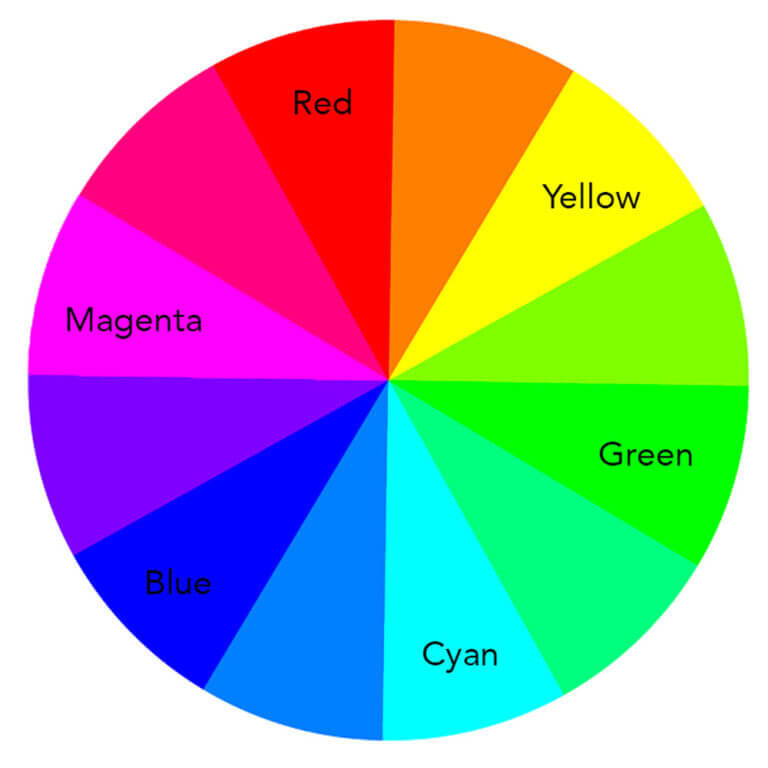
This is the true color wheel, based on the physics of light and including “fake” colors like magenta. The primary colors are red, blue, and green, and the secondary colors are magenta, yellow, and cyan. In between, and unlabelled on this diagram, are the tertiary colors. Clockwise, from red, they are: orange, chartreuse, mint, azure, violet, and rose. If we go into the colors between the tertiary colors and their neighbors, we just get into the quaternary (like keetorange, or “amber”) and then quinary colors, but then we’re splitting hairs with colors we can barely tell apart.
All of this matters because it reveals that our culture shapes color perception more than our actual biology. We think of red, orange, and yellow as so distinct that they each belong on separate chunks of the color wheel, and we lump blue, azure, and cyan together; yet each of these trios of colors are equally distinct. By contrast, the Himba people of Namibia categorize and distinguish color far differently from Western cultures, and this greatly impacts their ability–as well as our own–to discern them.
If you’re wondering what the hell this has to do with Bionicle, go back to Metru “blue.” We categorize it as blue, but as we just established, it’s not really blue–it’s azure, which is as far from blue as orange is from red.
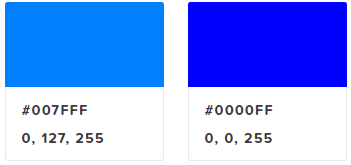
(For comparison: pure, fully-saturated blue and azure–essentially, Mata blue and a hypothetical “Mata azure”)
Moreover, different people perceive color differently in general. Not everyone sees colors as vibrantly (or at all), and I distinctly remember my parents arguing several times over whether some car was white or blue. All this means that trying to argue what colors should and shouldn’t go to a certain element is kind of a futile process.
Culturally, we’ve been conditioned to think of azure as blue. Let’s concede that, and let’s agree that Toa of Water have to be blue. Only…where does blue end? Even with the concession that it extends to azure, where does azure end? And where does blue become violet? Or does blue include violet? Or is this all wrong, and blue is only the pure, primary color blue–in which case, where does that end, and azure begin? Now try to set hard limits for what Toa of Water can and cannot be with all of these logistical problems in place.
Azure is not blue. Or, maybe it is, and orange is red. Or, it is, but orange is not red, and the lines between colors are completely arbitrary. However you cut the color wheel, elemental color schemes are a scam.