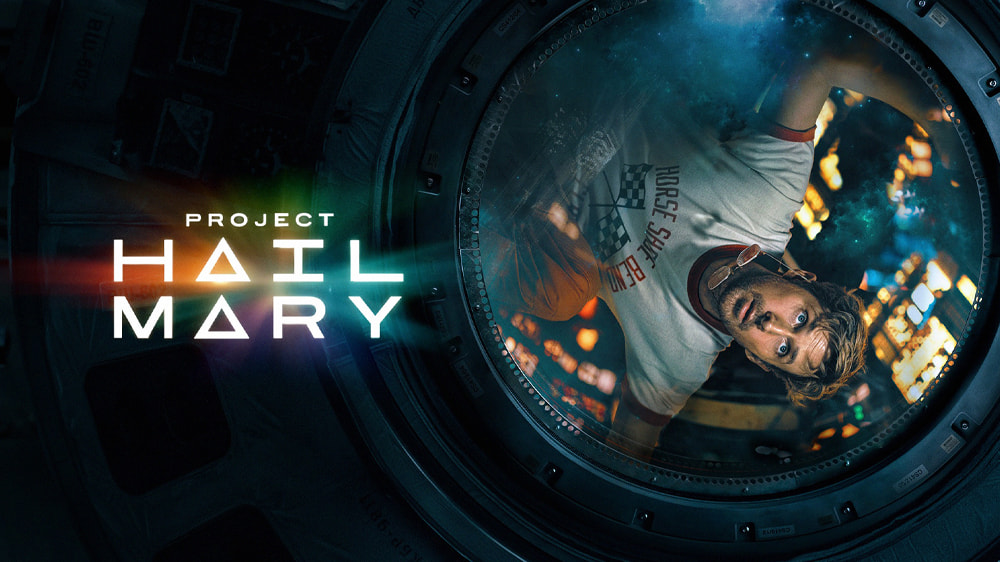
So I’ve avoided commenting much on the film because that’s what everyone else in the world is doing and saying basically the same thing, but I’ve recently had a couple observations which I think are actually unique, one of which I will now elaborate upon:
There’s a pretty big difference between the book and the film that makes them very distinct, separate stories, with each working better in its own medium.
In the book, Dr. Ryland Grace wakes up from his coma about the Hail Mary with the general assumption that he chose to be there. His memories return very slowly over the course of the book, dropping bits and pieces of the truth as he progresses towards Adrian, while his circumstances force him to be the hero he believes he is. However, as the last of his memories return, it’s revealed he was never a hero, cowering away from the idea of noble sacrifice and forcibly being placed in a coma to bring him aboard.
The film version differs dramatically from the book by having Ryland Grace’s gut reaction to be that of who he really is - not the shining standard of self-sacrificial bravery. His immediate consensus is not that he surely must have chosen to be there, but that he somehow got talked into doing it through unknown means, as he certainly doesn’t want to be there and is not committed to the idea or the mission whatsoever.
Hi views begin to shift with the arrival of Rocky, who much like in the novel is on the same mission he was pushed into undertaking, with the caveat that once a solution is found, he gets to return home. His presentation in the novel and the events that transpire are generally identical, but the minor change in Grace’s outlook radically re-contextualizes the scenes that follow - now Grace is shying away from self-ascribing the word bravery not because of modesty, but because of an unwillingness to accept it as a part of him. Rocky’s donation of fuel and sacrifice on his part enables Grace to actually become brave, because the agency to do so is fully within his control.
Of course, the final twist is changed as well. Grace now recalls he was forced aboard the Hail Mary, but outside of the mental distress the revelation causes, it holds narrative relevance as the following scene is Grace and Rocky’s parting - the emphasis is placed not on the twist itself, but reinforces the heartbreak of the departure as Rocky was the saving grace (heh) that gave him both agency and, as the former pilot said early in the film, someone to be brave for.
Now both narratives exist on a fairly neutral plane with each other; one is not better than the other, or more thought-out or bigger brained. Instead, one can exist only in the world of a novel, and the other only in the world of film, and each would see significantly difficulty trying to exist in the other medium. It may have been intentional on the filmmakers’ part to form it this way, it may be the happenstance of how the narrative played out, but in my opinion the slight change in his own self-perception made a tremendous difference on the plot of the movie as a whole - and definitely for the better.
Anyway, if you haven’t seen this movie yet do it do it do it do it do it do it do it do it