When you already had the prints ready and were building the MOC from them, did you ever have one of those moments of doubt, thinking that something could have been designed differently? Or did you actually predicted everything correctly and are completely satisfied with your work? Personally, I always notice a ton of things that could have been done better once everything is already finished.
4 Likes
Actually, I’d like to answer your question in a more detailed way, since I haven’t yet explained, either here or in the thread where I presented the TAFBS sketches, what my process looked like when analyzing which parts, and in what quantities, would need to be introduced as part of a single BIONICLE year in order to revive BIONICLE effectively, while at the same time avoiding unnecessary costs for the company.
You see, I didn’t start working on TAFBS by designing a building system. I approached the whole thing in a considerably more ambitious way: I put myself in the role of a LEGO employee, planned out an entire roadmap for the restoration of the series, wrote an initial outline of the story for it, estimated which sets should make up the first waves, considered what factors would determine the profitability of the theme as well as its ability to attract a new generation of kids to buying BIONICLE sets, and… only then did I start designing elements around that plan.
However, I’m a little busy at the moment and don’t have the time to write that answer for you, so for now I’ll just leave you with a small teaser of what I’ve been working on for the past two days 
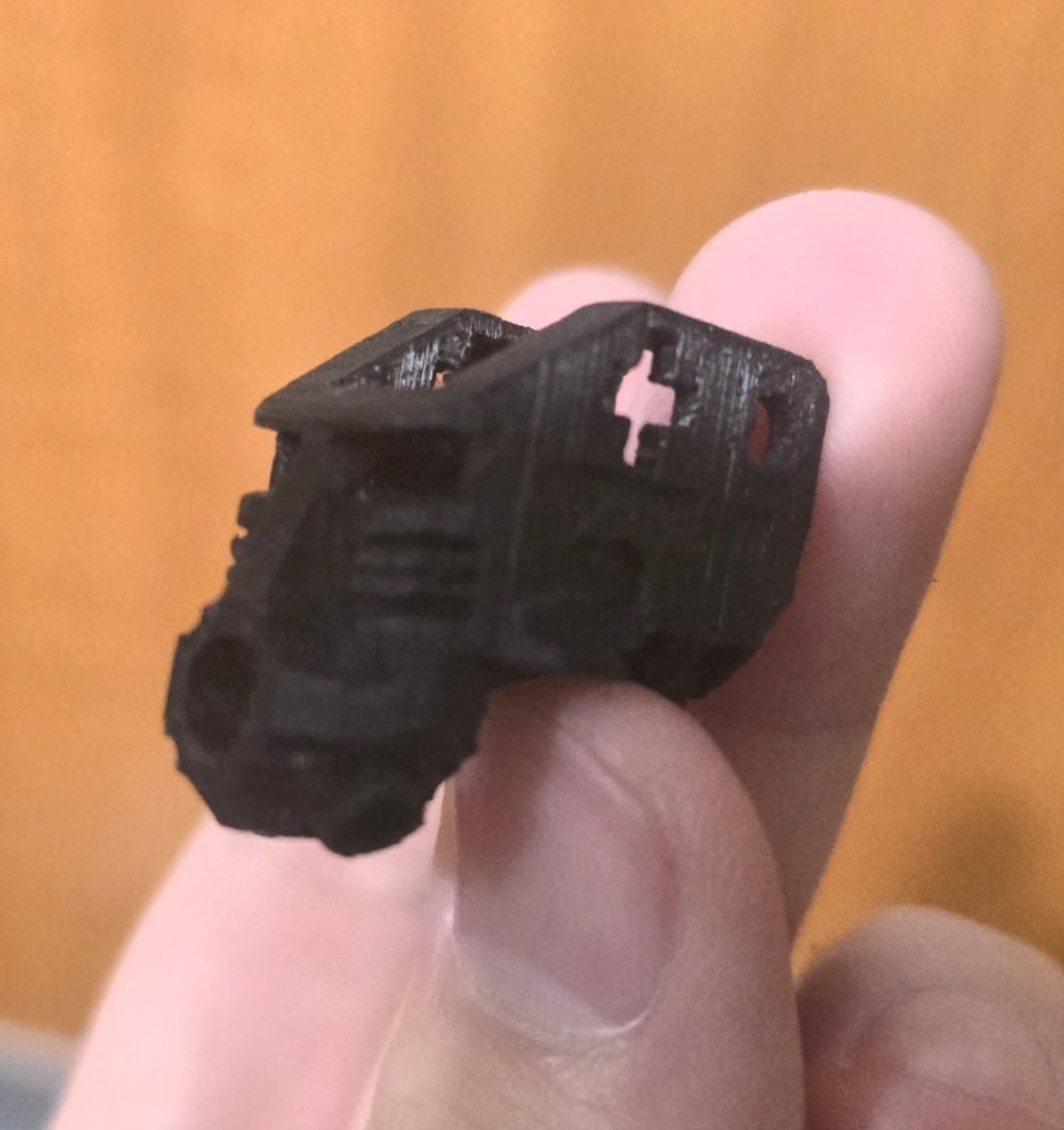
6 Likes
You weren’t kidding. This is really beneficial. Nice job making this.
4 Likes
Regarding the doubts that arose during the planning of TAFBS, they did, of course, come up a few times. I had them at four different points.
The first was between publishing the video with the sketches and modeling the first element. This doubt concerned the new torso based on the Toa Metru torsos. While I still believe that the Metru Build is the closest match to how all Toa looked in G1 canon (with the exception of those created in special ways, such as Helryx, who was the first Toa; the Toa Mata, who were specially designed creations of Artakha; or the Toa Inika, who were transformed into Toa with organic faces by the Red Star), and while I still maintain that splitting the Metru torso into two halves would give us a useful element for use in combiners, MOCs, and Rahi (e.g. as gorilla arms), over time I realized that my early design was too flat and did not scale well enough with TAFBS limbs. Therefore, I want to redesign this particular section from scratch.
The second moment of doubt concerned the shell with the knee joint. I was worried that it would be fragile (after all, it concentrates all the force required to move the leg at the knee), and I even considered putting a 2x2 circle at the end of the protrusion with the axle hole instead of keeping the width of a classic liftarm. This would naturally have required, among other things, an appropriate cutout in the shin armor. Ultimately, however, it turned out that ABS is surprisingly durable. You simply have to properly file the inside of the axle hole with a square file before attempting to insert an axle into it. Not a single prototype has cracked from use so far.
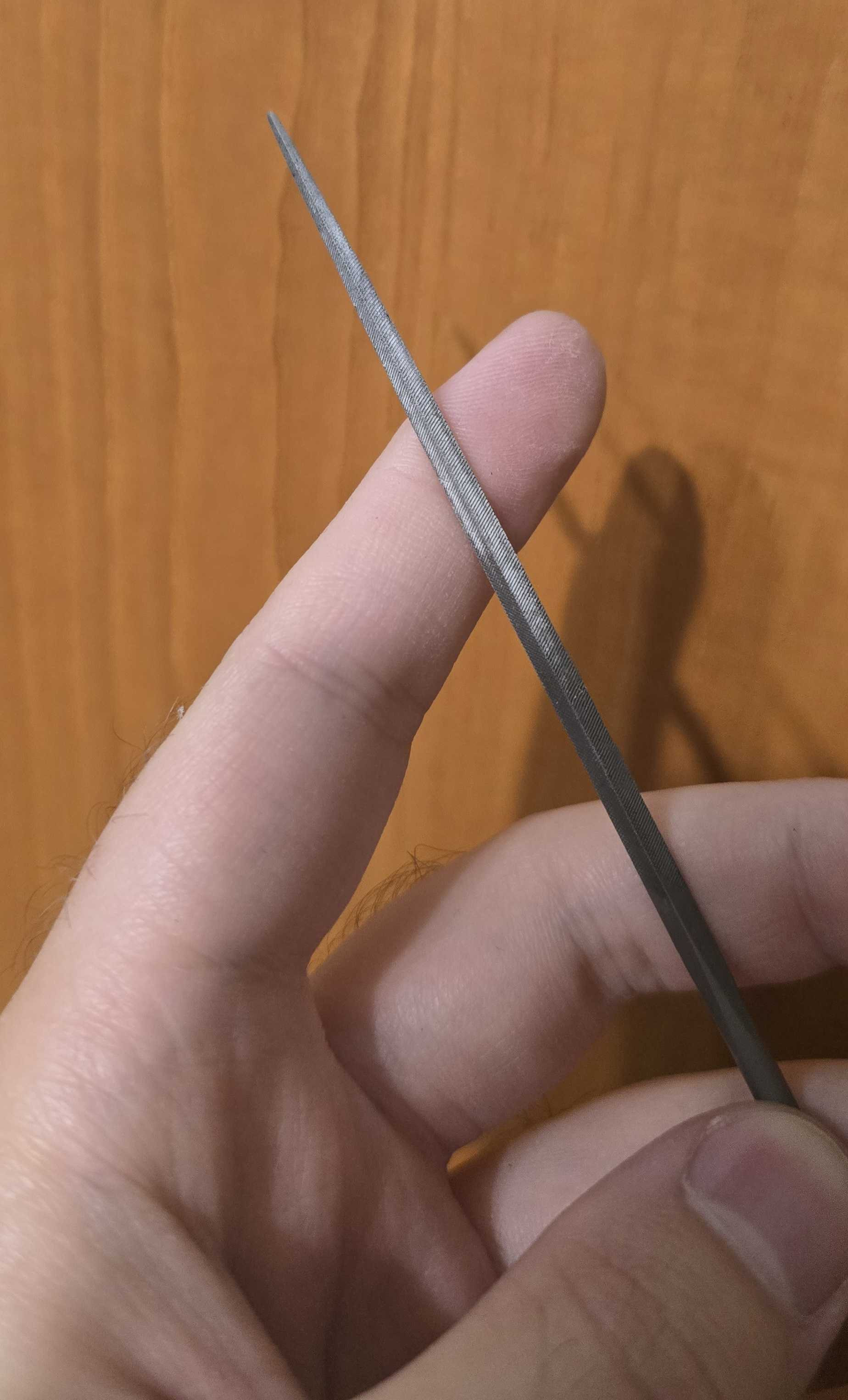
^ If you want to 3D-print axle holes, you definitelly need that tool, especially after smoothing the final product with acetone fumes.
The third, and most important one, concerned whether LEGO would actually be able to manufacture a TAFBS shell using injection molding, given that it has holes on all six sides. After all, such a mold would get stuck once the part was cast. For a moment, I considered getting rid of the shell’s rear wall. But then I remembered that LEGO has been manufacturing the part with ID 4733 for over 40 years, so I asked ChatGPT to explain to me in detail how that particular piece can be manufactured. After learning about technologies that use movable pins to create holes on the sides of a part, I abandoned my concerns. At the same time, I became even more motivated to make the TAFBS shells as versatile as possible, since the injection molds required for that particular brick would be more expensive than standard ones.
The final moment of doubt concerned whether the shin armor had turned out too large and too specialized. Of course, it fulfilled all the design requirements regarding its usefulness in Titan builds and Rahi, as well as the possibility of using it in System-based series, but that did not change the fact that it seemed rather large for ordinary Toa. My doubts only disappeared when I saw what the entire figure looked like after adding the torso and arms. The calf armor scales surprisingly well and offers quite a lot of room for customization when it comes to the build. However, I still have to design vambraces and shoulder pads that will complement this element. I also considered leaving two bar holes instead of the protruding hexagonal kneepad, so that a hexagonal CCBS armor piece (28220) could optionally be inserted there (that was the original plan), but ultimately I decided that said armor piece is the only still-produced element that would fit there anyway. This way, I can model its equivalent in the form of a frame with two through-holes, which would allow MOCists, for example, to thread a decorative tube through the holes. And as a bonus, I reduced the number of pieces required to build the leg. Although I might also model an alternative version soon just to see how it turns out, since I already have the base model finished. Maybe I’ll come up with something more interesting.
However, aside from these four minor details, my plan for the system had already been thought through in too much detail for any other unforeseen shortcomings to arise. And I think a large part of that comes from the fact that the entire design process did not start with the question, “What would the ideal Toa building system look like?”, but rather, “How would I structure the early waves of sets while being aware of the budgetary constraints resulting from the company’s philosophy?”
I knew that under the current CEO, the company had moved too far away from the things that allowed its old non-licensed themes to thrive for a full return of BIONICLE to be possible. What do I mean by that? Well, G1 got us accustomed to most years looking something like this: we would get two waves of sets each year, with one introducing 6 medium-sized sets and 6 small sets, while the other would introduce another 6 medium-sized sets, serving as the antagonists of the previous six, as well as an average of four Titan sets. On top of that, there would be one “booster pack” containing masks or ammunition. Obviously, there were exceptions, such as the number of small sets in the Mahri wave, or the first year of the theme, when the Toa did not get opponents from their own price range. But let’s use this simplified model to make it easier to draw conclusions. The thing is, such a release strategy was possible thanks to two factors. First, LEGO was more willing to introduce larger numbers of new specialized molds each year. Second, it was possible to recycle molds useful for BIONICLE from previous years and related themes such as Slizers and RoboRiders. Even LEGO Technic offered much nicer Technic panels back then than it does today, and they worked very well with the theme’s aesthetic. BIONICLE G3 will unfortunately not have it that easy. LEGO has robbed us of too many crucial parts.
Above all, we need to acknowledge one problematic fact: bringing BIONICLE back would require not only introducing the molds necessary to build the entire figure. We would also need at least 6 new masks and 6 new weapons.
Even if we assume that the best solution would be to bring back the 12 masks from 2001 during the first two waves (and update their original designs by replacing the studs with axles), that would only save the design team the effort of coming up with the shapes of the masks. There would still be the costs associated with producing the injection molds, which are expensive. And sure, a single mask could be worn by even a dozen different characters, as long as it received additional color variants (Toa Mata colors, Turaga colors, the darker colors of the Toa Metru, rarer colors such as purple, teal, sand blue, sand green, yellow, etc.), so as long as a new generation of BIONICLE fans were properly taught that a mask is not an individual face, those 6–12 masks could be recycled for several years. But the sets still need to be distinguishable from one another. We can’t exactly put 6 good Toa wearing Toa Mata masks against 6 evil Toa wearing Toa Mata masks. With an annual limit on new molds, the body construction and variety of weapons would still not be enough to completely avoid the feeling of clone sets. And blades mounted on axles introduced through Ninjago, DREAMZzz, and Monkie Kid don’t fit BIONICLE’s aesthetic particularly well (Chima ones were great tho). In other words, unless the company happened to keep a few molds somewhere just in case (such as the Rahkshi blade that was recycled for Toa Pohatu in 2015), LEGO’s policy of getting rid of molds after 5 years will have financial consequences for the company when the time comes to bring BIONICLE back.
What I’ve said so far may seem like common knowledge, but I took the subject a step further—I asked myself what should actually be included in the first two waves of sets.
Aside from the need to design a new building system from scratch, because a Technic build is a key aspect of BIONICLE’s identity and pretty much every dedicated fan would prefer a new building system over Mixels and System-based solutions, and aside from the need to introduce new masks and weapons, we also had to remember that the Toa themselves would no longer be as affordable as they once were. Therefore, the composition of the set waves would have to take that into account as well. We have to give less rich kids a chance to buy whole the team before the new Toa will disappear from LEGO Stores.
I quickly came to the conclusion that the best possible solution would be to… repeat what LEGO did in 2001, but with a few minor changes to adapt that strategy to the realities of 2026. The keyword is: Rahi.
Apart from the Manas Crabs, most of the Rahi from 2001 can still be built using modern parts. Sure, with less emphasis on tubes, without access to Onua’s claws or Gali’s hooks, and using less versatile technical panels. But many things can be replaced with newer pieces. And on top of that, if we introduced a new building system like TAFBS, these elements would further increase the potential for interesting constructions, with better articulation than, say, the Nui-Jaga.
I started visualizing these Rahi, first taking the G1 sets and looking for sections that relied on discontinued parts, then, in my imagination, replacing those sections with assemblies using modern pieces, and finally visualizing them in an improved version using the elements I would design for the Toa. For example, a TAFBS thigh—with a through-hole running along its entire length, the width of a Technic beam—would make it easy to thicken the Tarakava’s skinny arms, making them look more muscular. A TAFBS foot, with its “toes” facing downward, could serve as a thigh for an animalistic limb, such as that of an Iron Wolf. But it could also work as a nose, as well as a base for building the head of some kind of beast like a Kikanalo.
In the end, I decided that the best tactic LEGO could adopt in terms of financial strategy would be to release the sets in the following configuration:
Wave 1:
- 6 Toa with Toa Mata masks
- 1 large Rahi as the boss of the wave
- A CMF-style booster pack containing 3 random masks (with 100% chance that at least two of them will be recolors)
Wave 2:
- 6 story-relevant Matoran from that year, with Noble Turaga masks
- 6 Rahi at roughly canister-set scale, maybe a bit more complex if needed
- A jar of parts (similar to the Ultimate Creatures Accessory Set)
Why this configuration? It comes down to how the introduction of individual elements into LEGO’s library would need to be spread out over time.
Starting with the Toa, the team would consist of a nostalgic lineup representing the classic elements:
- Toa of Fire (Red with Orange accents)
- Toa of Ice (White with Sand Blue accents)
- Toa of Air (Green with Lime accents)
- Toa of Earth (Black with Light Gray accents)
- Toa of Water (Blue with Azure accents)
- Toa of Stone (Reddish Brown with Tan accents)
Each would have a mask matching the dominant color of their color scheme.
The Toa would be packaged in a new type of canister: a transparent hexagonal container made from environmentally friendly plastic, with 6 axle holes running around its circumference both near the bottom and near the lid, allowing the canisters to be connected into a wall, similar to how the Bohrok canisters could be arranged. Instead of a screw-on lid, the canisters would have sliding drawers, which, once you had collected a larger number of them, could be used to sort your LEGO pieces. This way, BIONICLE fans would get the iconic canisters back, we would stop wasting paper on packaging that people simply throw away, and a secondary market for the packaging would emerge, reducing the amount of waste in the process. A child would have somewhere to keep their LEGO pieces sorted, and if they weren’t interested in that, the canister could find a use in dad’s workshop or mom’s kitchen. A win-win situation.
Since LEGO would already have spent a considerable amount on molds during this half of the year, I doubt the company would be willing to design unique weapons for each Toa. Therefore, the biggest compromise for this wave would be introducing a single universal blade variant that would be easy to customize and could serve as a dagger, spearhead, extension for a double-edged sword, etc. Something along the lines of Kopaka’s sword, but with bar connections at the bottom and the ability to put the colorful bars running through the center of the core (as was done with the swords in LEGO Chima).
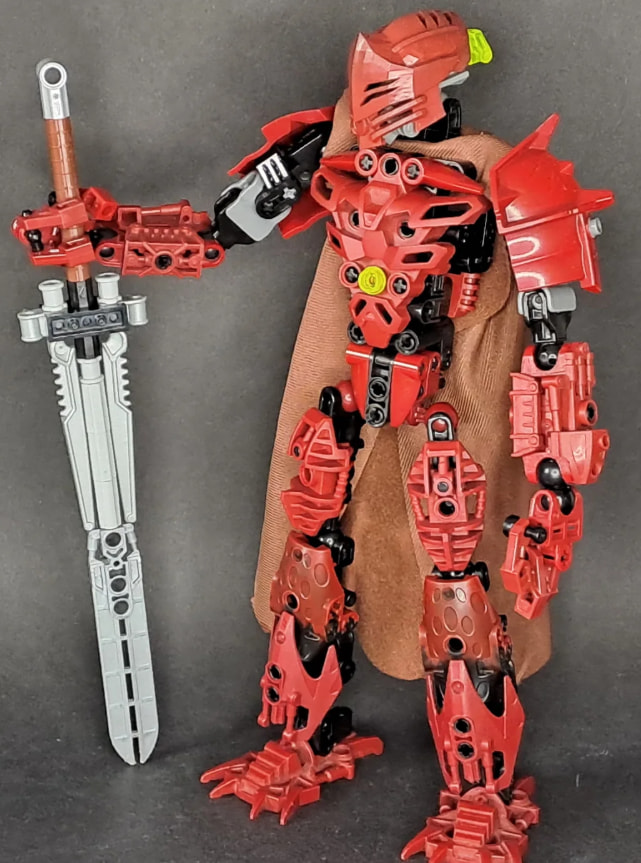
Here, you can see a MOC built by karbon.2003 - my friend from PDB (Polski Discord BIONICLE). He created a sword perfectly showing how Kopaka’s sword can be creatively used for more advanced weapons.
Check out his Instagram, he designed way more of interesting Toa Tools.
Toa of other elements would be introduced in Year 3 as part of Wave 5, bringing with them new mask colors, such as purple, orange, and teal. These new Toa would be evolutions of the Matoran from Wave 2, so instead of introducing entirely new characters from scratch, it would be possible to promote characters that fans already cared about. Also, until that wave, LEGO would have enough of time to introduce more diverse bricks for Toa builds. First team has to have at least two years to shine before their role will get smaller.
But moving on to the Rahi, I would build a LEGO Technic-based Titan inspired by the Tarakava, retaining its punching function and its dropping head using a spring-loaded locking mechanism. I would even top its nose with a mask in a color that none of the Toa use (either as a primary or secondary color), but I would make the following changes:
- a larger head with a movable jaw, inspired by Fenrakk
- a pair of plastic link-tread tracks made from individual segments instead of a single rubber track, allowing Rahi to turn and, if a fan wanted to, even to be motorized
- a bulkier, somewhat spherical chest, using small variants of the new Technic p anels (as in my The Nameless Hero)
- a “spine” made from Technic liftarms rather than long System bricks with pin holes
This redesigned Tarakava, perhaps under a new name as a new species of Rahi, would be the boss of this half of the year. This would reduce the number of sets to 7, making it easier to collect the entire Toa team in light of LEGO sets being more expensive than they used to be. This is important because the Toa would not be replaced by a new team in Year 2, which would instead focus on the villains. Also, larger focus on Technic bricks in Rahi build would reduce the production costs, at the same time, teaching kids who are interested only in the story-driven themes that LEGO Technic sets are also worth of buying, as they give you bricks useful for BIONICLE MOCs.
As a bonus eighth set for this wave, there would be the mask packs. These would allow fans to create their own Toa and Matoran by simply swapping the color scheme and mask on sets they already owned. If LEGO made an effort to promote the idea of creating original characters (perhaps even self-MOCs through some kind of Role Play competition, where fans would be tasked with placing their character within the events of the story and adding their own adventure to the series’ lore), as well as educating the new generation that a given mask only defines your element and grants you a specific Kanohi power (Miru grants levitation, while the Lime color is associated with the elements of Air and Plantlife), and that putting on a red Hau doesn’t automatically make you Tahu, then the booster packs could motivate wealthier fans to buy certain sets multiple times, perhaps even encouraging them to create entire Matoran villages associated with a particular element.
G1 also introduced mask packs, but it made one particular mistake—the existence of Toa other than the Toa Mata was not established until the fourth year, which was also the first year that did not offer recolored masks. As a result, most children saw this collectible aspect as rather unappealing. Because, let’s be honest, Tahu looks so ■■■■ cool with his red Hau, so why would you put a red Pakari on him? Only MNOG could really inspire a child to experiment with this, but unfortunately, the game required knowledge of English, which immediately excluded almost all of Europe from the experience.
The second wave, on the other hand, would introduce 6 Matoran (I already have a build in mind, but it would require introducing 2 new molds) representing secondary elements such as Iron, Gravity, Lightning, Plasma, Plantlife, and Sonics (in this case, assuming a color scheme based on shades of gray with black), but wearing Noble Kanohi. These Matoran would have to play a sufficiently important role in the story to become fan favorites, as in Wave 5 they would become Toa, receiving Great Masks and expanding the recolor palette with new colors that would not appear during the first two years. Instead of weapons, Matoran would receive simple tools such as spears, fishing rods, pickaxes, drills, saws… basically, everyday working tools made from pieces already available at this point. This would take some pressure off the company, which would not have to spend money on additional molds for them.
Personally, though, I would introduce something along the lines of the backpack piece I plan to model and release sooner or later.
The medium-sized sets in this wave would be somewhat simpler Rahi (simpler than Tarakava, Muaka or Kane-Ra and not sold in pairs), on the scale of the Nui-Jaga or Skull Scorpio, but with better articulation. Since the Rahi could be built without the need to introduce any new molds, using only the ones from Wave 1, I would use this wave for something else—for introducing the concept of weapon powers. Just as every Kanohi has a power, I would introduce 6 blade variants and include them with the Rahi as weapons that the Toa from the first wave could obtain after defeating the Rahi that serves as their elemental counterpart. By assigning a power to each blade, I would create a narrative justification for recycling these new pieces in future waves.
On top of that, each Rahi would have the same mask as its corresponding Toa as part of its body, but in the Toa’s secondary color. Why? To encourage MOCing, obviously. You could even give this a narrative motivation. Something along these lines:
“Our Toa are not the first team to venture into this region. Long before them, a team of legendary warriors once came here. Powerful Titans, whose deeds have become legends and serve as an inspiration to their inexperienced successors. Combine the Toa with the Rahi and bring the ancient myths back to life!”
This way, you could introduce 6 new characters into the lore at very little cost, without having to produce additional sets. All it would take is for a fan to purchase two sets, build the combiner according to the instructions, swap the Toa’s mask for the new color variant, and there you go. You have a different character. Yet another incentive to buy sets in pairs, or even purchase multiple copies in order to have both the base sets and the combiner.
And we could also bring back the Toa Kaita concept, combining the Toa of Water, Ice, and Earth into one Titan, and the Toa of Fire, Air, and Stone into another. On top of that, there would be the possibility of combining the Rahi with one another. And the Matoran. And Matoran with Rahi… As long as the new building system is sufficiently modular, the possibilities are endless. And we wouldn’t even have to dump the responsibility for designing all these Titans/Combiners on the Creative Team. We could announce various competitions and introduce the winning designs into canon. Every canonized Combiner would be a marketing tool encouraging people to purchase the same set multiple times. Dividing limb segments according to the TAFBS concept would only increase the potential inherent in the ability to combine sets, turning BIONICLE into a profit-generating machine that no System-based theme could ever become. It’s the potential exclusive for BIONICLE theme.
Overall, if the TV series accompanying the sets were also backed by a mature, complex dark fantasy story aimed at a teenage audience, giving every Combiner its own narrative background, G3 would have no right not to sell.
LEGO is currently in such a financially stable position that they can afford to experiment with the formula and do something more risky when it comes to the way the story is told. People have been waiting for years for LEGO to bend its anti-violence policy a little in favor of a better, more serious story. And since Niels B. Christiansen really cares about AFOLs so much that he floods us with 18+ dust collectors, then bringing story-driven theme focused at the most ignored age group would be a natural & needed evolution of his politics.
And finally, the last, 13th set of the second wave, and thus the 21st set of the first year: a product that should become a permanent part of LEGO’s lineup, even for years after BIONICLE itself comes to an end—a Technic equivalent of LEGO Creator in the form of a jar of parts (perhaps one that is a larger version of the Toa canisters I mentioned earlier). The jar would contain enough of distinctly BIONICLE-specific elements (limbs, feets, armors, weapons, heads, ball-and-socket connectors) as well as LEGO Technic elements (pins, axles, liftarms, Technic panels) to make it possible to build a complete Toa and a complete Rahi from its contents simultaneously. The main incentive to buy it would be that the available colors of these parts would allow you to build Toa and Rahi in new color variations (we all know how much people love replacing Whenua’s ball connectors with the Sand Green variant, or Vakama’s with Keetorange). On top of that, the jar would contain masks in colors exclusive to the set that complement the rest of its contents, and perhaps even one bonus booster pack with random masks. Naturally, these new color variants would stop being exclusive for that set a year later, because LEGO wouldn’t introduce new versions of a piece specifically for a single set due to the costs involved. The jar would instead serve as a sort of early access to parts that would later become more common thanks to the humanoid villains of the second year (with whom I would make much more extensive use of gunmetal parts, which are sorely lacking on BrickLink at the moment).
The jar would also provide additional justification for the huge number of parts introduced during the first two waves, extending their lifespan and making it worthwhile to continue producing them.
Turaga would be introduced in Year 2 (perhaps the Toa’s task would be to rescue them from the new enemies?), but those are plans that go beyond what I wanted to discuss here. The same goes for plans to introduce Toa of Magnetism and Psionics, for whom I would exclusively reserve color schemes utilizing silver and gold, whose overuse was one of the problems that turned the G2 Toa into a colorful mess. I believe these two colors should be reserved for exceptional characters.
In any case, the entire business plan I’ve shared with you is only about one-third of what I’ve mapped out in my head in order to figure out what challenges a new building system would have to overcome. I haven’t even mentioned my ideas for the story or how I would connect it to G1, and that alone would be a write-up three times the length of this post xD
Anyway, after seeing just how versatile the system would need to be, and estimating the minimum number of molds necessary for the first year alone, I could finally start planning the design language for TAFBS, constantly asking myself what the best balance would be between what old BIONICLE fans want, how a new generation thinks, and what would make financial sense for LEGO given how the company operates in the modern era.
What I have suggested is essentially an improved version of the strategy from the period when BIONICLE was bringing LEGO its highest revenues, before the concept of mask recolors was abandoned and before Rahi and combiners were pushed into the background. Therefore, while I am sure this plan would not have been completely free of flaws, I am also certain that if LEGO had followed it when they brought BIONICLE back in 2015, while also providing a complementary, well-written TV series telling a story from beginning to end, with proper attention paid to the Matoran characters, the theme would have lasted at least 5 years, and perhaps would have continued to this day.
In reality, the key to bringing BIONICLE back essentially comes down to three factors:
1. Designing a new BIONICLE building systemwith an easy-to-learn design language, consisting of parts that are as versatile as possible and offering a multitude of ways to customize a figure’s design, so that the system actively encourages building combiners and MOCs.
2. Introducing new molds in a carefully planned manner(if I were a LEGO employee, I would even introduce a basic TAFBS shell as an experiment in Ninjago Mechs, a year or two before BIONICLE returned, and see how it was received by BIONICLE fans).
3. Writing an engaging story that encourages theorizing & making theory videos (especially among YouTubers). It would have to be less childish than Ninjago, Chima, DREAMZzz, etc., and aimed more at a teenage audience (the only demographic LEGO currently ignores), take itself seriously (every LEGO theme overuses jokes and slapstick, so having one theme that breaks this rule would be a welcome change), be properly complex (G1’s complexity wouldn’t have been a problem if the story had been consistently adapted for TV show), and not be afraid to dynamically change the status quo. Understanding that BIONICLE became a cult classic thanks to its skillful blending of dark fantasy with sci-fi and a touch of horror is crucial.
Finally, just so I don’t have to make a separate post, I’ll add that the design of the TAFBS head visible in the photo I sent earlier was specifically thought out to allow masks to be easily implemented as parts of Rahi builds. It can be easily incorporated into the body of a beast thanks to strategically positioned axle and bar holes. I’ll talk more about the head itself another time, because there is a chance that the design may still undergo some drastic changes before I release the final file 
(Yes, I always overthink things :p)
4 Likes
I don’t think this has necessarily changed; LEGO’s just less willing now to invest in so many new molds for non-licensed themes. After all, Super Mario’s January sets next year are introducing around 16 new molds. (By contrast, Ninjago only introduced around 14 new molds across all of 2026.)
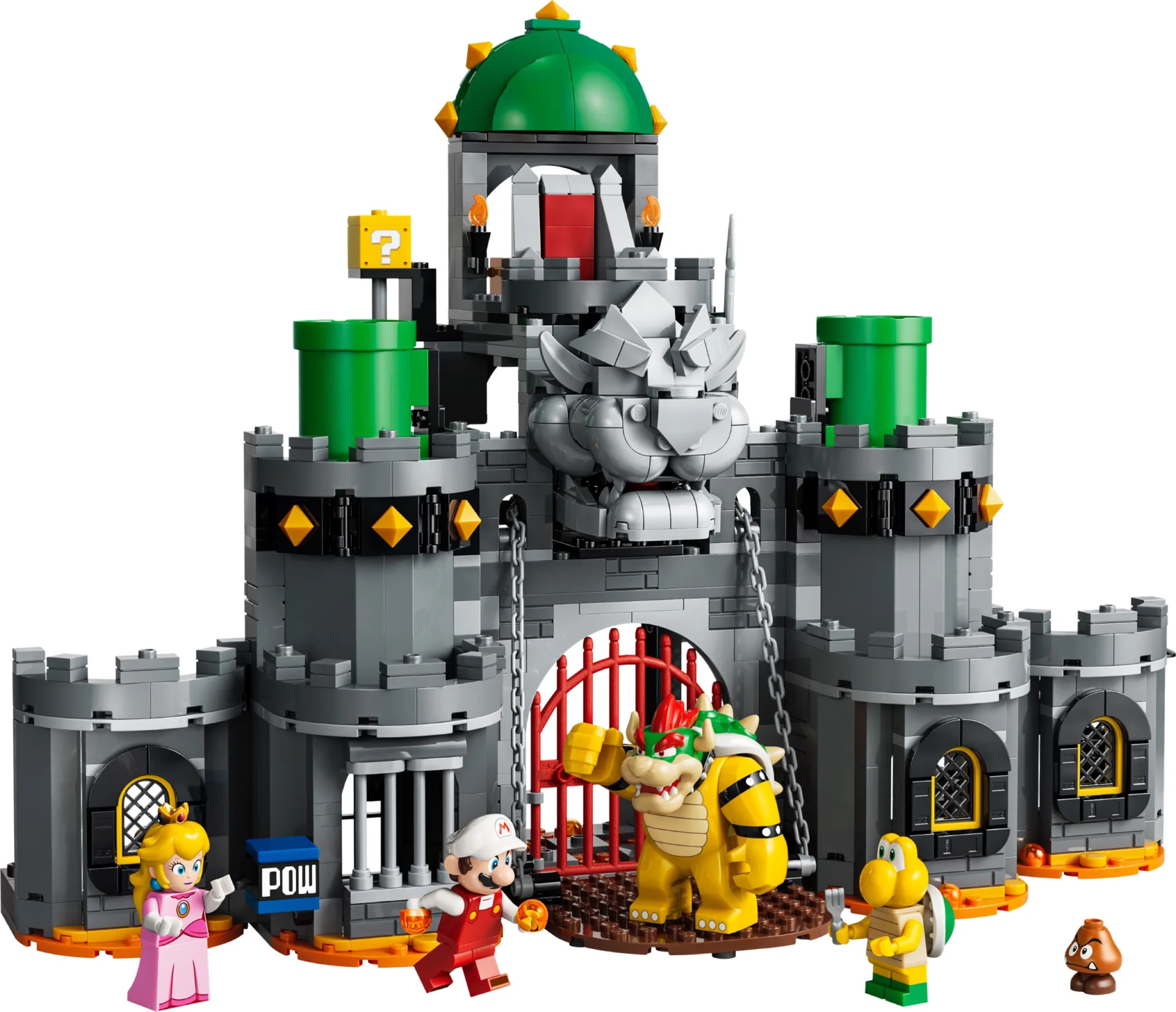
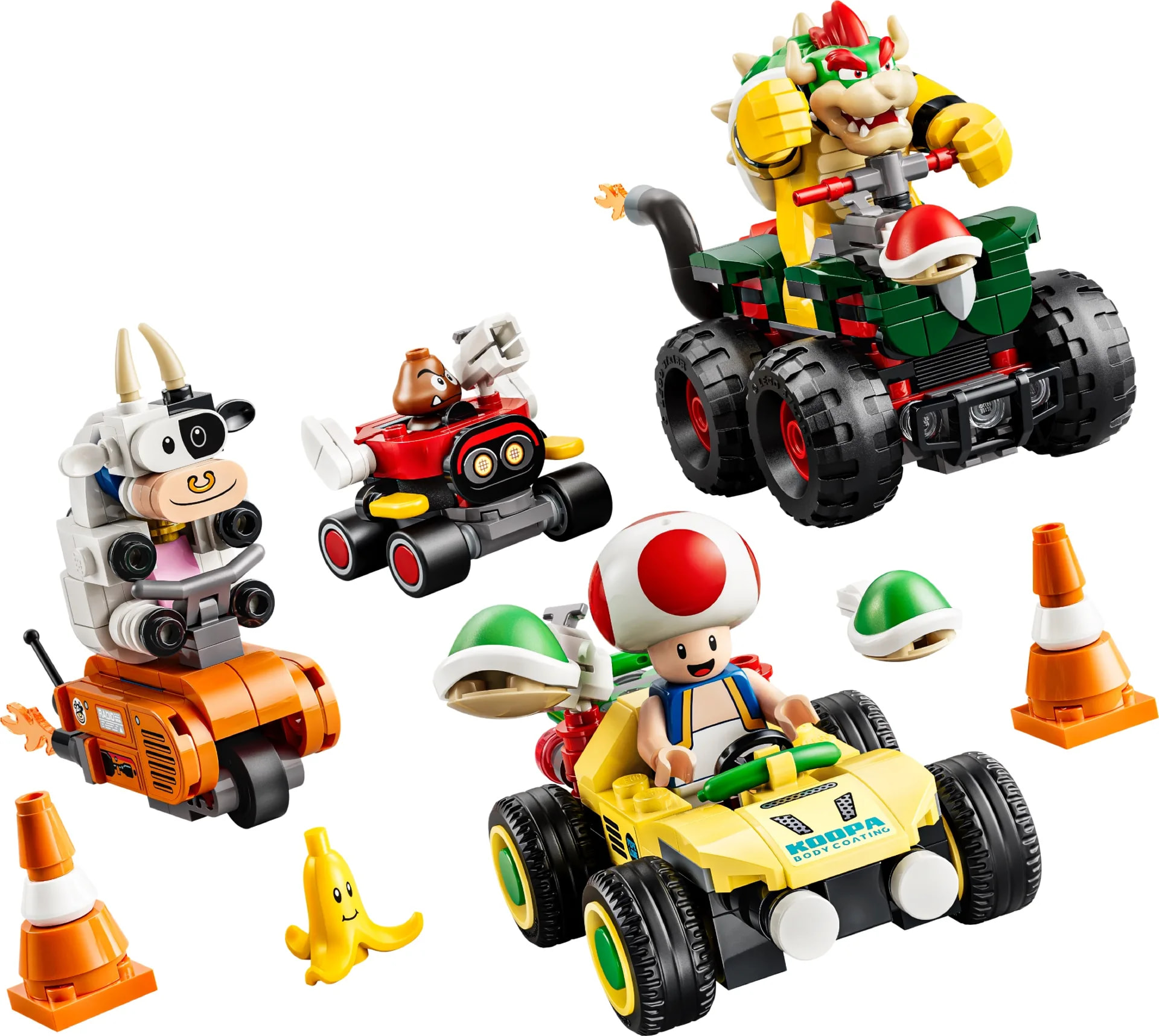
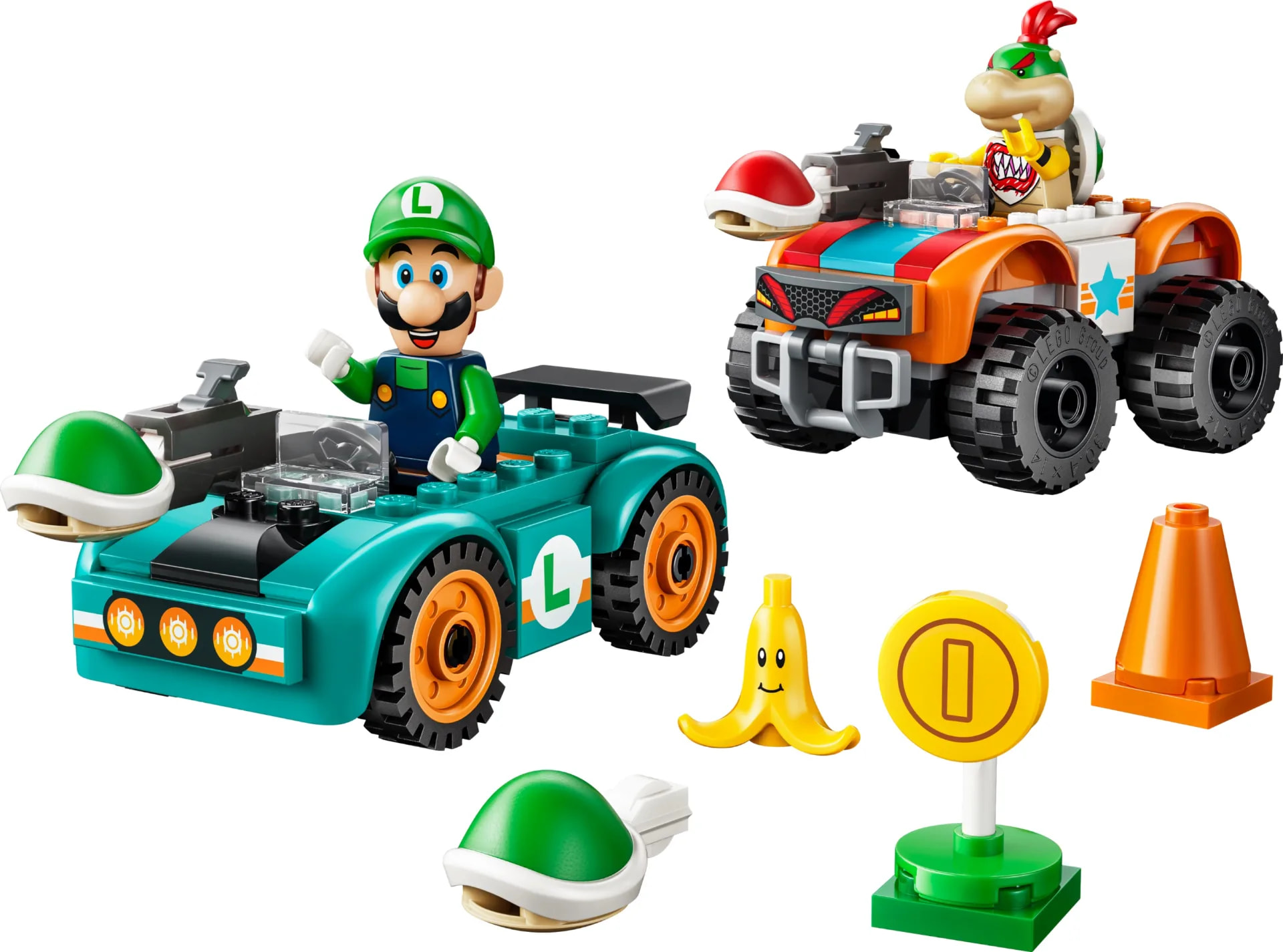


So, if they wanted to make a strong initial investment, they are fully able to… just not as willing.
4 Likes
The problem when it comes to the number of new molds is LEGO’s new approach to how the company is run. We can assume that the decision-making process looks something like this:
“We need to squeeze more money out of Mario fans, now that we’ve acquired the rights from Nintendo to make money off their IP. Mario fans want minifigures inspired by the classic game characters, and the recent movie has boosted their popularity, so it makes logical sense to invest money in new injection molds for this theme.”
And then, when it comes time to talk about BIONICLE:
“BIONICLE fans want their theme back, but bringing it back would require investing money in a ton of new injection molds because we destroyed the old ones. The problem is that we’ve neglected this IP since 2011, and we completely screwed up G2 in 2015, so it’s hard to say whether we wouldn’t repeat that failure. People expect a specific level of quality from such a legendary theme, and there’s no guarantee that we’d be able to deliver it. If the investment carries a risk, maybe we should just give up on trying to make use of our own IP and ignore this particular niche?”
In order to stabilize the company’s finances, LEGO changed its policy regarding the introduction of new molds around 2004, significantly lowering its upper limit and more frequently asking itself whether a particular mold was actually necessary. As far as I understand by looking at the older sources, the original limitations meant roughly 30–50 new molds per year when it came to bricks designed for building sets, plus additional minifigure accessories such as hairpieces and weapons, which were counted separetly. Depending on the source, the number of new injection molds introduced over the course of a year grew from around 95 in 2004 to as many as 325 in recent years, with this increase being driven by LEGO’s expanding portfolio of IPs for which it acquired licenses. Mario, Sonic, or Pokemon are LEGO themes that simply wouldn’t work if LEGO refused to create new molds specifically designed for figures replicating the appearance of iconic characters.
So let’s assume that, judging by the trend of the last 22 years, LEGO would be willing to introduce 350 new molds in the year BIONICLE G3 launches. The first two BIONICLE waves would require at least three variants of the bone piece (two for Toa, one for Matoran), armor pieces for individual body sections, a new head variant, a foot, a brain piece, etc. That already gives us roughly 10–13 new molds. Let’s take the upper end. Add 12 Kanohi masks to that, and at least 7 new blade variants. That gives us around 32 new injection molds required for the first year of this one theme alone.
Sure, most of these new molds would remain in use for the entire duration of the theme, and perhaps one-third, maybe one-quarter, of these elements could be easily used in themes other than BIONICLE. Besides, I think Star Wars, Harry Potter, and other LEGO themes will somehow manage without yet another redesign of Vader’s helmet, while Marvel can survive without another element representing the effect of using a superpower.
So it would seem that dedicating 9% of the annual budget for new molds to molds introduced specifically for BIONICLE shouldn’t be a problem. We would still have over 90% left to distribute among the other themes.
But this is where another issue comes into play, one that is often overlooked: recolors.
New color variants of an element may use the same injection mold, but they still exist within the system as separate element IDs that require separate storage. And even if we exclude printed elements (BIONICLE never really needed them; personally, I think G2 would have been better off with a decorative chest piece featuring a universal engraved pattern instead of messy prints) as well as stickers (I doubt any BIONICLE fan would want stickers in this theme), every element, except for heads and weapons, should still be produced in anywhere from 6 to 12 different color variants. And this raises the additional question of how willing LEGO would be to dedicate more warehouse space to a single theme.
Mario or Yoshi only appear in one color, but Kanohi Hau should be available in a minimum of 6 colors, and optimistically, even 26, if LEGO understands how important the collectible aspect is to the identity of the theme, as well as how efficiently that investment could be monetized if they can convince fans to build their own characters and canonical combiners.
We cannot allow a repeat of the 2004–2011 situation, where every mask appeared in only a single color, often one that was of limited usefulness because some masks were dual-molded, forcing a second, often undesirable color into the color scheme. Although, to be fair, this was nowhere near as unbearable a plague in G1 as it was in G2, where we didn’t even get a single clean Protector or Uniter mask.
Also, to ensure good look of the figures, LEGO should finally undo their biggest mistake in terms of LEGO Technic bricks and bring back Black Axles 3L, Black Axles 1L with Pin, also introducing Black Axle 3L with Stop.
As I mentioned earlier, LEGO’s financial situation is currently stable enough that the company could afford to experiment and go wild with spending on BIONICLE G3. There is no chance that a single theme could threaten that stability. I’m simply trying to present a business-plan proposal for a scenario in which LEGO decides to give us the absolute bare minimum.
But of course, you’re right. If LEGO actually believed in BIONICLE, and if the company’s current CEO finally started taking care of IPs that are actually owned by LEGO and only by LEGO, rather than treating Ninjago as an immortal cash cow whose existence, in his view, justifies not launching other, more specialized story-driven themes, then yes, I doubt it would be a problem for the company to introduce even 75 new injection molds designed exclusively for BIONICLE. After all, we have a ton of BIONICLE fans in the Creative Team and in other departments. The only problem is that people on the highest positions, who are the only entity that can give the rest of the company the green light, don’t care about our community enough to restore the BIONICLE now, when old fans finally have jobs and own money for buying BIONICLE.
Unfortunatelly, as consumers, we don’t have an access to numbers that are necessary for drawing accurate conclusions. We can only create theories and suggest the solutions that seem to be the best and most logical based on our observations and available data. So even when what I wrote in this post seem to suggest the optimistic scenario, I still think that my conclusions from previous post were closer to the truth. Especially since the more complicated molds are more expensive in production than, for example, new heads from the Sonic theme.
5 Likes
The day before yesterday, I got a package with a few shells of both types that I ordered from a friend so I could experiment with the two pieces and see how well they work in practice. I haven’t built anything worth showing off yet, but there’s one thing that came to mind while building that I wanted to ask about.
What role do other species, like Steltians, Vortixx, or Skakdi, play in your plans for “ Bionicle G3”? You haven’t mentioned them in any of your posts. Are you planning to make any special parts for them or somethin’?
3 Likes
Hi, Netrus! A few weeks ago, I had my parts printed by JLCPBC…
They arrived!
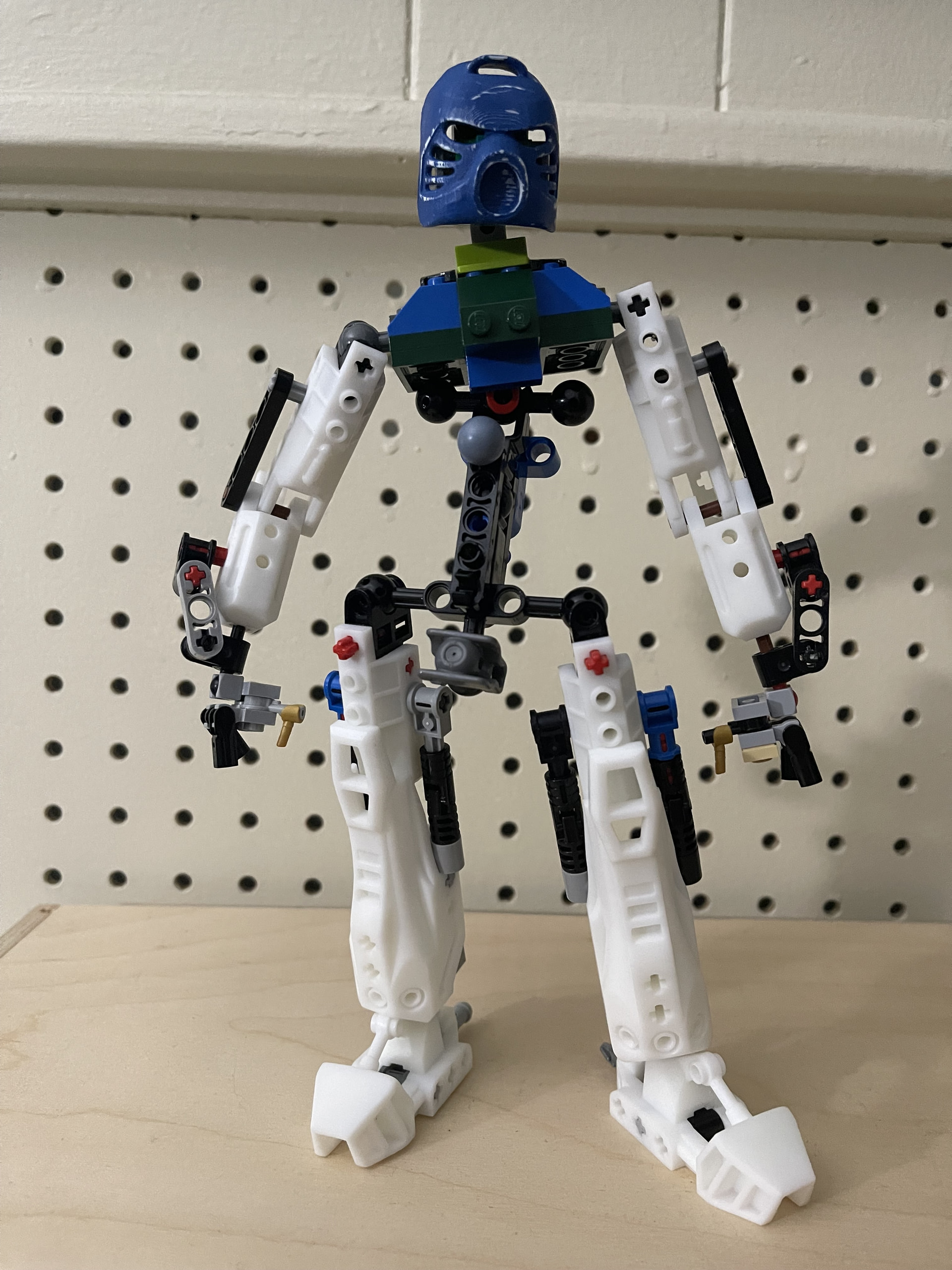
They were printed in 9600 resin. The resin did expand when it cured, so the holes are loose and the studs are tight. And if you are wondering why I didn’t use normal ball joints on the ankles, knees, elbows, and wrists, that is because I don’t have any through-axle ball joints. I had to get creative lol.
I love the parts!
7 Likes

 the shelek came in two colours, on chirox and mutran.
3 Likes
This is true 
1 Like
I forgot to add “almost” to that sentence. Or maybe, I remembered it, but it somehow got lost when translating the post from Polish into English.
RedPandalorian, I’m impressed by how you managed to build a complete figure without using a single ball joint at the elbows, wrists, or knees. It’s an interesting approach, even if it was put together rather quickly.
They look really good and smooth when printed on the different type of 3D printer. Way better than what I have to work with after taking the finished print from the printer xD
As for the issue of hole dimensions, as I mentioned, the dimensions in the SolidWorks model are not what they ideally should be for axle holes, bar holes, and studs. They were calculated in the original model, but I adjusted them so that they would come out as close as possible to the intended dimensions after being printed on an FDM printer using ABS+ filament. Unfortunately, I don’t own a resin printer, so I have no way of estimating the optimal dimensions for that printing method.
I would need to know the exact dimensions of the resin-printed parts in millimeters, accurate to two decimal places, for every individual bar hole and every individual axle hole. In the case of axle holes, I would need as many as three dimensions: the radius of the hole, the vertical spacing of the axle groove, and the horizontal spacing of the axle hole.
I dimensioned every hole individually, depending on the thickness of the wall in which the hole is located and how far that hole is from the edge of the print. So that would involve quite a lot of measuring.
If I had the exact dimensions of every individual hole on a resin-printed part, I could match their dimensions to the dimensions of the holes in the original LEGO elements and create a second STL specifically for resin printers, adding or subtracting the difference. But, as you can probably imagine, that would be a lot of work that I would then have to repeat for every future model. And even then, those dimensions would probably need to be adjusted for other materials such as PETG, PLA, etc.
That is precisely why I included the .STEP file in the folder — to give people an easy way to edit the models and adapt them to their individual materials. That’s unfortunately just the nature of 3D printing. At least TAFBS eliminates the problem of having to print the most difficult type of connection: ball joints. ^^
-
As for the question about the Vortixx, Steltian, and Skakdi, their omission stems from my view of how the story of BIONICLE G3 should be structured. I believe that, since every race would have to be introduced from scratch in order to properly familiarize new audiences with that race’s lore, they should be introduced more gradually than they were in G1.
On top of that, I would deliberately set the G3 story in a location where the first three years could focus primarily on Toa, Matoran, Turaga, and Rahi. Especially since the latter would serve both as an initial threat before we introduce more significant antagonists and, as representatives of the local fauna, as a way of defining and enriching the ecosystem. So we would be killing two birds with one stone.
After all, TAFBS is designed so that its elements are versatile enough not to restrict MOC builders to humanoid forms specifically in order to enable the construction of a wide variety of Rahi as early as during the first two waves of sets.
I would only start introducing other races, with less narrative significance, from the fourth year of the series onward — assuming their presence in the new location would be justified.
As for the Skakdi, I don’t see much point in designing dedicated parts for that race at this stage. Skakdi are essentially Toa with rubbery spines and different heads. They can use the same skeleton as Toa built around the TAFBS framework. And we can replace the spines with hose pieces and with tubes, as printing them would be a nightmare.
When it comes to the more Titan-like races, let’s take a moment to look at their design language in G1:
Sidorak, Roodaka, Axonn, Brutaka, Umbra, Maxilos, Hydraxon, The Shadowed One… All of these characters used a similar construction scheme. A Toa foot covered with LEGO Technic elements (sometimes not and sometimes connected to some bigger base), with a lower leg from one of the medium-sized sets attached to it, sometimes supported from the back by a Technic piston, followed by a custom thigh built mainly from Technic elements. The thigh was terminated at both ends with a ball joint socket in the variant with the axle hole oriented along the axis of the element rather than across it, and decorated with the foot of some Toa, used here as armor. Obviously, there were exceptions, such as Nidhiki, but most Titans repeated this scheme.
In other words, the Titans that LEGO would have to design for BIONICLE G3 would not need a huge number of dedicated parts. LEGO Technic already provides a pool of parts that is fully sufficient to build a Titan, even with the current parts library.
The arms were even simpler, since very few Titans had arms that differed significantly from those of regular Toa. For the most part, they simply had a somewhat more complicated hand build.
As for the torsos, they were either custom LEGO Technic builds with ball joint sockets allowing the limbs to be attached, with only the armor section using distinctly BIONICLE-specific elements, or they used the Inika Build with only slight modifications to make it more complex, like it was solved in Brutaka case.
For example, try building Sidorak using currently produced parts, without worrying about color accuracy. Apart from the chest armor and shoulder armor, we are able to build an almost complete torso.
In short: Titan = Canister Set + common LEGO Technic bricks.
Besides, the problem with BIONICLE in 2026 is not that it is completely impossible to build BIONICLE figures. It is possible to build a complete figure by making custom feet, thighs, lower legs, etc., using only through-hole balls, Hordika necks, Glatorian necks, and standard ball joint sockets.
When building a Titan, the real problems are essentially limited to the head and mask. Although in the case of races that do not wear Kanohi, even the head can be built somehow.
However, the real problem that needs to be solved is the issue of figures at Toa and Matoran scale. Custom limbs always end up longer than we would like, because the number of stable assemblies that can be built at a smaller build scale is severely limited.
That is why, when designing TAFBS, I am focusing primarily on Toa and (soon) Matoran. Because as long as TAFBS shells offer enough possibilities for creatively covering them, building a Vortixx, a Steltian, or any other race from the Matoran Universe will be trivial. It might even be easier than it was during G1.
All you have to do is look at how LEGO did it between 2004 and 2009. The only thing I therefore need to pay attention to is designing armor for Toa built around the TAFBS system in such a way that these parts are as useful as possible for Titans.
Obviously, it would be worthwhile to come up with multiple variations of armors featuring different, race-specific textures, just as LEGO did in G1, but TAFBS is currently being designed with the first two waves of BIONICLE sets in mind, so I am aiming for the bare minimum necessary. Just LEGO would.
So, when designing TAFBS, there is no need to think about creating a unique design language for Titans. That language already exists. The only challenge is figuring out how to replace element ID 47326px2 from the G1 builds with TAFBS shells.
The only remaining unresolved problem is LEGO discontinuing element ID 98613, which was indispensable for increasing friction in ball joints. Without it, the only ways to properly reinforce a thigh so that a half-meter-tall figure like Kardas could support its own weight would be either to build a double joint, inspired by the solution used in Takanuva 2008 and Tuma, or to use a similar solution to the one I employed in my Marendar, consisting of simply spamming ball joint connectors throughout the thigh build.
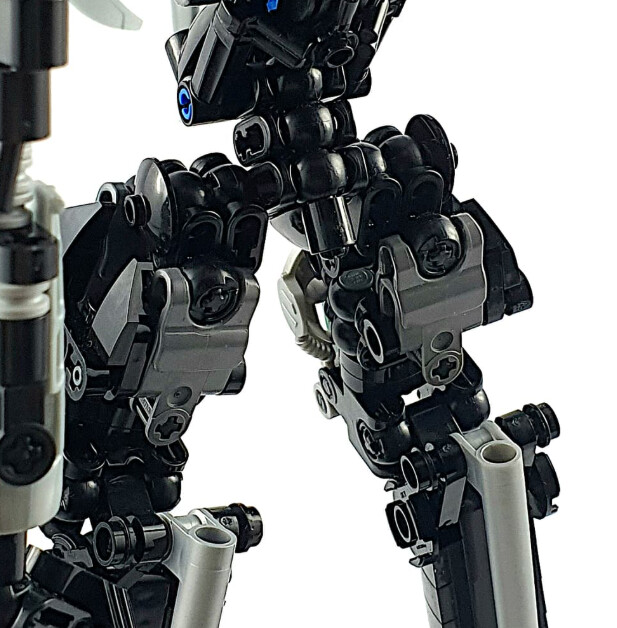
The good news is that this solution is still achievable with the current library of parts that are still in production.
In short, there is no reason to worry about TAFBS being unsuitable for building Titans, about the scalability of builds based on the TAFBS system, or about me not proposing a dedicated design language for these builds.
Of course, if any of you encounter any potential problems, I would be happy to work out and share a few ideas for designing Titan limbs. However, I feel that the instructions for the G1 Titans should provide more than enough inspiration. And LEGO Technic has gained many unique parts since the days of G1.
And speaking of new parts, within the next week I will be adding two new elements to the folder containing the TAFBS files.
5 Likes
Okay, as promised, albeit perhaps a little later than I said I would, (it’s all your fault, Kanohi Garai), I’m back with another two TAFBS elements.
Let’s start with the element that requires less explanation — the new, slightly shorter version of the shin guard.
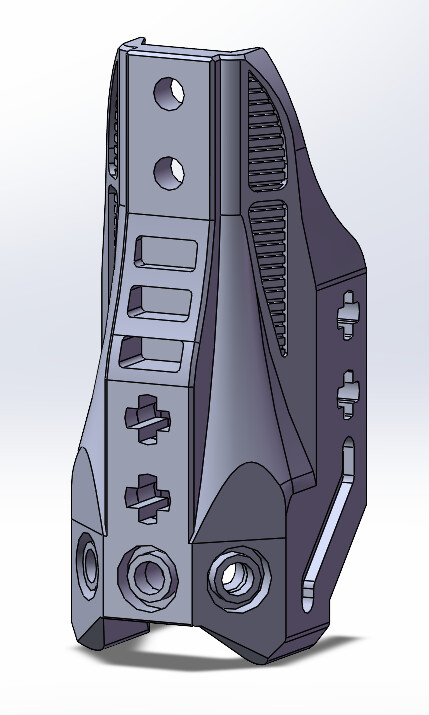
Although I don’t consider the previous shin guard a bad design, there was always something missing from it. It was too smooth, not detailed enough, and too close to the CCBS aesthetic that I was trying to move away from when designing the TAFBS system.
So I went through the concept arts for the Toa models from the “Mask of Light” movie, analyzing how Miramax approached the design of the legs. I eventually realized that the problem with my design was that the armor tapered too quickly. So I added wider side walls. I also rounded off the back of the leg, so that instead of a rectangular protrusion at the back of the piece, the rear section would become more decorative. I also cut down the top of the element, getting rid of the decorative kneepad in favor of a solution closer to my original design assumptions. However, I still felt that something was missing in terms of detail. So, after two days of thinking it over, I cut a decorative recess into the newly added side walls and filled it with a striped texture, imitating a corrugated pipe or ventilation grille running underneath the armor.
I tried to make the new shin guard capable of serving a similar function in MOCs as the armor piece from Fire Lord from Hero Factory. The new design made the TAFBS shin guards more versatile, as they can now also be used as Titan forearm armor and, at a larger build scale, even as wrist armor. At the same time, the number of added details isn’t so overwhelming that they detract from the versatility of the new armor.
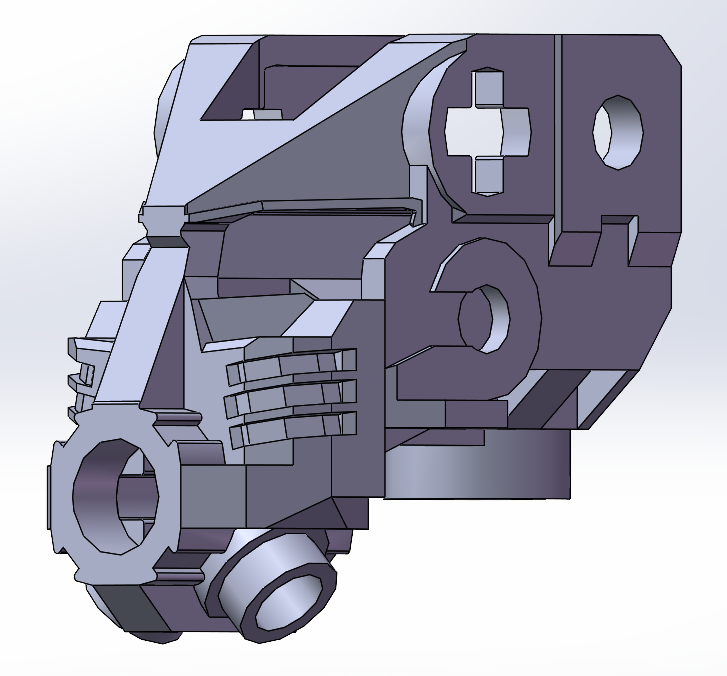
The second element, and also the element I spent the most time designing, is the TAFBS head.
The basic design assumptions were: using a method of attaching the head to a ball socket similar to the one used for TAFBS Shells (by inserting a black 3L axle with stop, with a ball slid onto it, into the axle hole) and ensuring that the new head would be compatible with all G1 and G2 masks. With the obvious exceptions of Hordika masks, rubber Inika masks, and masks such as the Gorast’s or Krikka’s masks, since their attachment methods are so different from everything else that designing a completely universal model would simply not be possible. I considered also making the TAFBS head compatible with Glatorian helmets and Hero Factory helmets, but when LEGO designed these pieces, they didn’t consider compatibility with other heads, leaving so little space underneath that the head would have to be extremely small — and therefore fragile — to allow those helmets to be worn.
Designing the basic model according to the original concept was easy, but I quickly ran into two problems: some of the Uniter masks sat very tightly against the chin, while the visor on the Toa Mahri masks dictated a specific shape for the upper section of the head.
And once I had what I thought was a perfect model, I tried putting on the Kanohi Garai and it turned out that… it sits so close to the forehead and nose that I essentially had to redesign the entire upper half of the TAFBS head so that it was almost identical to the Toa Metru heads, which made my original idea lose some of its character.
However, as you can probably expect, I eventually managed to find the best possible compromise, because otherwise I wouldn’t be writing this post, right?
So let’s move on to discussing the unique aspects of the new model.
As you can see, from the outside, the upper half of the TAFBS head does not differ all that much from the Metru heads. The only more noticeable details are the additional bar holes on the sides, positioned behind the axle holes running across the head, and the fact that the brain is held in place by axle holes rather than pin holes, as is the case with the Toa Metru and G2 heads.
This increases the versatility of the piece, making it easier to mount it in creative ways, which is particularly useful when building Rahi, where Kanohi Masks form part of the creatures’ body. The TAFBS head can easily be incorporated into a Rahi’s body, providing a conveniently positioned attachment point for the mask. The TAFBS head also has slightly wider eyes, making them more visible once a mask is attached, as they allow more light to pass through.
Below the axle hole are G2-style “ears”, allowing 2015–16 masks to be attached to the TAFBS head. To prevent them from drooping downward under the force of gravity, I included a protruding shelf beneath the “ears” to provide a support point.
At the bottom of the head is a short neck with a through-hole for an axle. In accordance with the TAFBS system’s design language, this is where an axle with a ball is inserted, allowing the TAFBS head to be connected to a ball socket. The shorter neck makes it easier to push the axle out of the mask hole from the back if, as is often the case with 3D-printed Kanohi, the axle gets stuck in the hole or, even worse, breaks off from the mask. On the Toa Metru heads, the neck irritatingly got in the way, making the whole process more difficult.
The most interesting section is definitely the bottom part of the front of the head, as this is where I had the most freedom during the design process. The first thing that catches the eye is the mouth, styled to resemble the Kini Nui Temple. This is a nod to the Toa Mata heads. The inside of the mouth was designed similarly to the Toa Metru head: it consists of a stud hole transitioning into an axle hole, ensuring full compatibility with both Toa Mata and Toa Metru masks.
Slightly above the mouth, on the cheeks, are three pairs of diagonal grooves meant to resemble the Mata Nui Stone. The elongated nose also references the stone, although I had to shorten it slightly compared to the original design because it interfered with the front of the Kanohi Garai.
Also drawing attention are the two studs with bar holes on the chin. Besides serving a decorative purpose, they also provide an additional attachment point where we can insert tubes or attach several studs imitating a breathing apparatus. This allows us to create an aquatic version of any mask without having to model it with an integrated breathing apparatus, like the Kanohi Volitak worn by Nuparu Mahri.
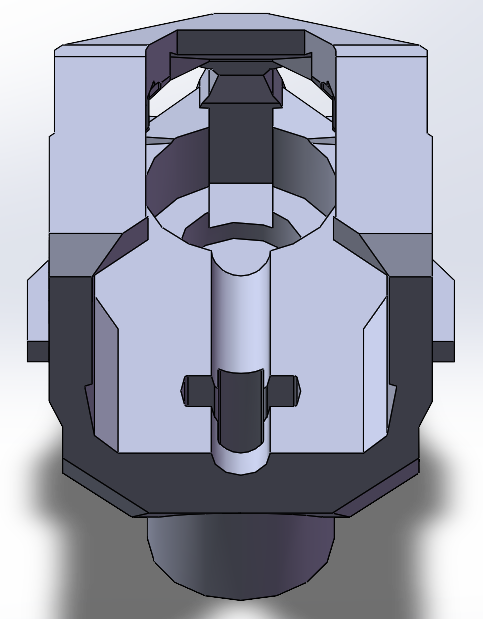
You will certainly also be interested in the unusual interior of the brain slot. It stems from my desire to ensure three things:
The first was, naturally, to make sure that the TAFBS head was compatible with Toa Metru brains.
The second was to allow MOCers to build MOCs with heterochromia (different-colored eyes) by inserting transparent 1x2 plates across the head, following an idea by user Scullmaister, that was later popularized by Skybirdmakes.
The third was to include an upside-down stud hole in the bottom of the brain slot, allowing LED lights to be placed inside the TAFBS head, like the ones shown in the photo below:
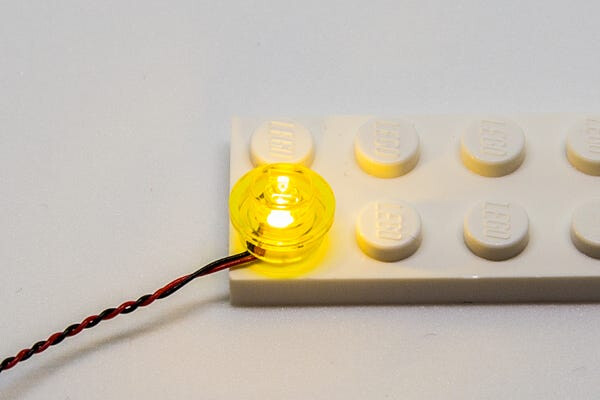
You can easily fit such a transparent stud under a brain piece.
A thin, elongated groove runs from the stud hole, allowing a cable to be easily routed through the head.
Despite the very thin walls of the head, whose dimensions were dictated by the design of the masks and brains produced by LEGO, the TAFBS head is surprisingly durable, which naturally results from the mechanical properties of ABS+ filament. It offers high compatibility with almost all masks from both BIONICLE generations and was designed to visually reference G1 while simultaneously being practical for building MOCs.
Both elements I presented today have already been added to my public folder, so you can test them out for yourselves.
I would only like to remind you that all hole dimensions were chosen to account for the thermal shrinkage of ABS+ filament and may require modification before printing on a resin printer or using a different filament. For this purpose, I have provided you with files in the .STEP format, allowing you to edit the models in most 3D modeling programs.
Alright, time to get to work on designing the chest armor.
5 Likes
I’d like to order resin prints of these parts, but I’m concerned about the dimensions. Could you please export alternative versions of these pieces with the holes scaled so that, in the program you use, each hole has the exact same dimensions as the ones LEGO uses?
2 Likes
Sure, but I need someone to tell me what dimensions should the .STL model have for the resin prints to have proper dimensions.
In theory:
-stud diameter = 4,8 mm
-axle hole diameter = 4,8 mm
-wall spacing in the axle hole = 2 mm
-bar hole diameter = 3 or 3,1 mm
But is there someone who could confirm that such dimensions on the base model would give the expected result after printing on resin printer?
3 Likes